


Post-column derivatisation in amino acid analysis – explained in an understandable way
The differences between pre-column and post-column derivatisation can be seen particularly clearly in the analytical process. The decisive factors here are the timing of the chemical reaction and its influence on the chromatographic separation.
The following diagram compares both approaches and shows why post-column derivatisation is considered methodologically stable in amino acid analysis.
The determination of amino acids places special demands on detection. Since amino acids themselves are hardly detectable directly, derivatisation is necessary. Two basic approaches have become established in amino acid analysis: pre-column and post-column derivatisation.
This article explains what post-column derivatisation is, why it is so methodologically stable and why it continues to be used as the reference method in many laboratories.
Why amino acids need to be derivatised
Amino acids do not have any pronounced chromophoric groups. Without chemical conversion, they therefore provide:
- hardly any usable UV or VIS signals
- low sensitivity
- poor comparability
Derivatisation produces detectable reaction products and is therefore a prerequisite for reliable quantitative determination.
Basic principle of post-column derivatisation
In post-column derivatisation, the chemical reaction only takes place after chromatographic separation.
The amino acids are first separated completely and then react with the derivatisation reagent.
In classic amino acid analysis, ninhydrin is used for this purpose.
The process can be described in simplified terms as follows
- Chromatographic separation of amino acids
- Continuous addition of the reagent
- Conversion in a heated reaction section
- Photometric detection of the reaction products
It is crucial that separation and derivatisation are strictly separated from each other.
Reaction chemistry with ninhydrin. This reacts with primary and secondary amino groups to form coloured reaction products.
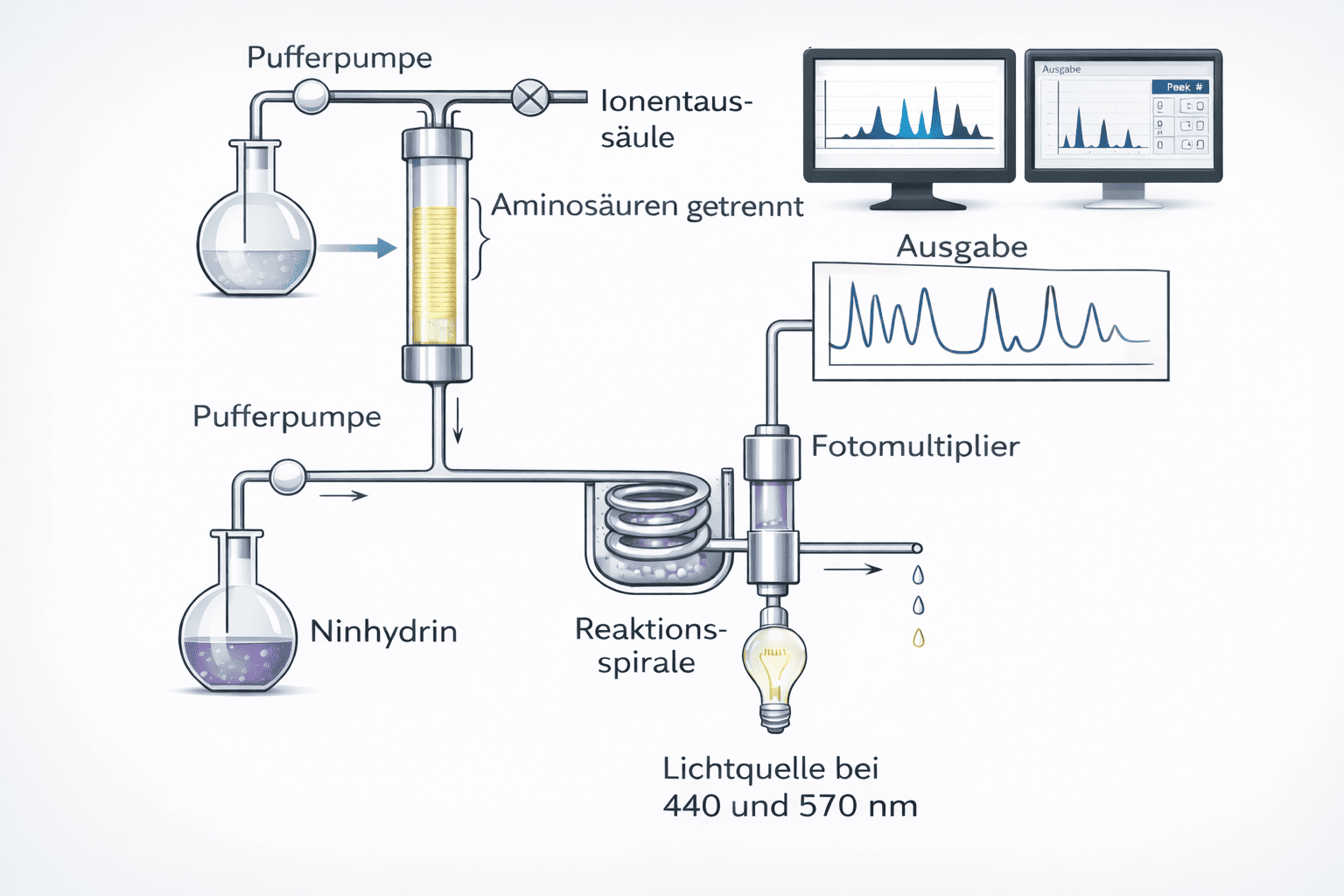
The illustration shows that in post-column derivatisation, chromatography remains completely independent of the derivatisation reaction.
While even small deviations in reaction time, reagent concentration or sample matrix can influence the separation behaviour in pre-column methods, only the already separated eluate is converted in post-column derivatisation.
This methodological decoupling is one of the main reasons for the high reproducibility and long-term stability of dedicated amino acid analysers.
The reaction is:
- chemically well reproducible
- reproducible for every amino acid
- stable under defined conditions
The resulting signals are proportional to the respective amino acid concentration.
Significance of temperature and reaction time
The reaction takes place under controlled conditions:
- defined temperature
- constant reaction time
- continuous reagent flow
These parameters are crucial for signal stability and reproducibility and can be kept constant in the system.
Advantages over pre-column derivatisation
The main advantage of post-column derivatisation lies in the methodological decoupling of separation and detection.
Uninfluenced chromatography
Since derivatisation only takes place after separation:
- retention times do not change
- separation performance remains stable
- matrix effects are reduced
The chromatographic behaviour of the amino acids remains unchanged.
High reproducibility
Post-column methods deliver:
- stable signals
- good comparability between measurement series
- low dependence on sample matrix and operator
This is a decisive advantage, especially in routine operation.
Lower validation effort
Since derivatisation has no influence on the separation, changes in reagents or minor system adjustments need to be revalidated less frequently than with pre-column methods.
Typical sources of error and how to avoid them
Even robust methods can encounter problems. The most common include:
Reagent quality
- Ageing or contamination of ninhydrin
- Incorrect storage conditions
→ Consequence: unstable or fluctuating signals
Temperature stability
- Deviations in the reaction distance
- Inadequate control of the heating modules
→ Consequence: altered signal intensities
Flow and mixing conditions
- Uneven reagent supply
- Air bubbles or leaks
→ Consequence: reduced reproducibility
These issues are technically easy to control, provided that the system and operation are consistently coordinated.
Why this method is still standard today
Despite modern alternatives, post-column derivatisation continues to be used because it:
- is clearly defined methodologically
- delivers reproducible results
- has been validated over decades
- is well compatible with regulatory requirements
It therefore remains firmly established in many official methods and reference procedures.
Summary
Post-column derivatisation is not a historical relic, but a deliberately used methodological concept. By separating chromatography and derivatisation, it enables stable, reproducible and long-term comparable amino acid analysis – especially in routine and quality environments
Let’s Discuss Your Specific Requirements
We take the time to truly understand your situation. What types of samples are you analyzing? What is your weekly throughput? What are your specific requirements for reproducibility and system uptime?
In a direct conversation, we’ll determine if the Biochrom B30Plus is the right fit for your workflow - and how we can support you for the long term. No pressure, just practical advice from experts who speak your language.
Proven Performance. For Over 25 Years.

Years on the Market

of All Issues resolved over the phone

Response Time

Key players across 8 countries
